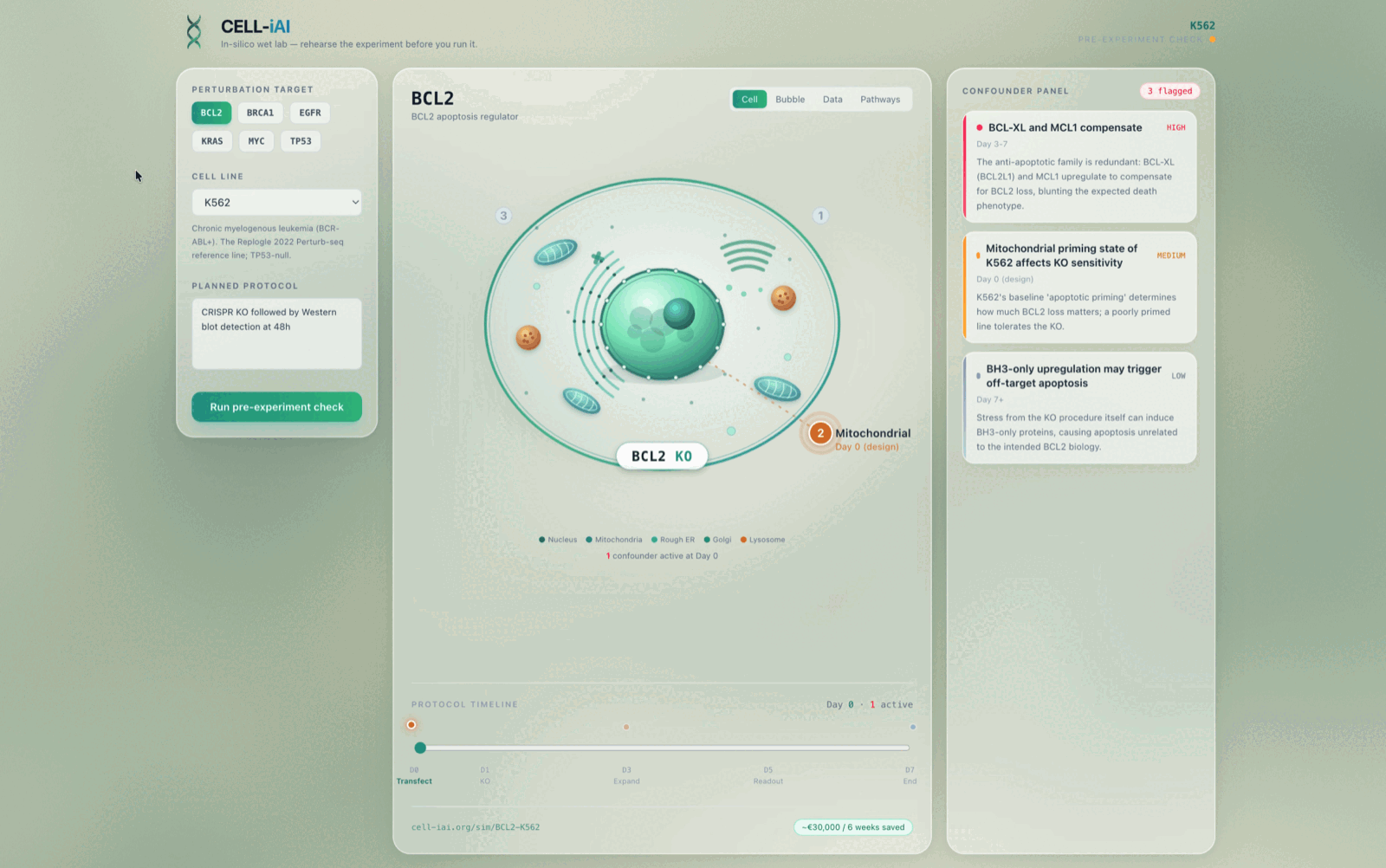
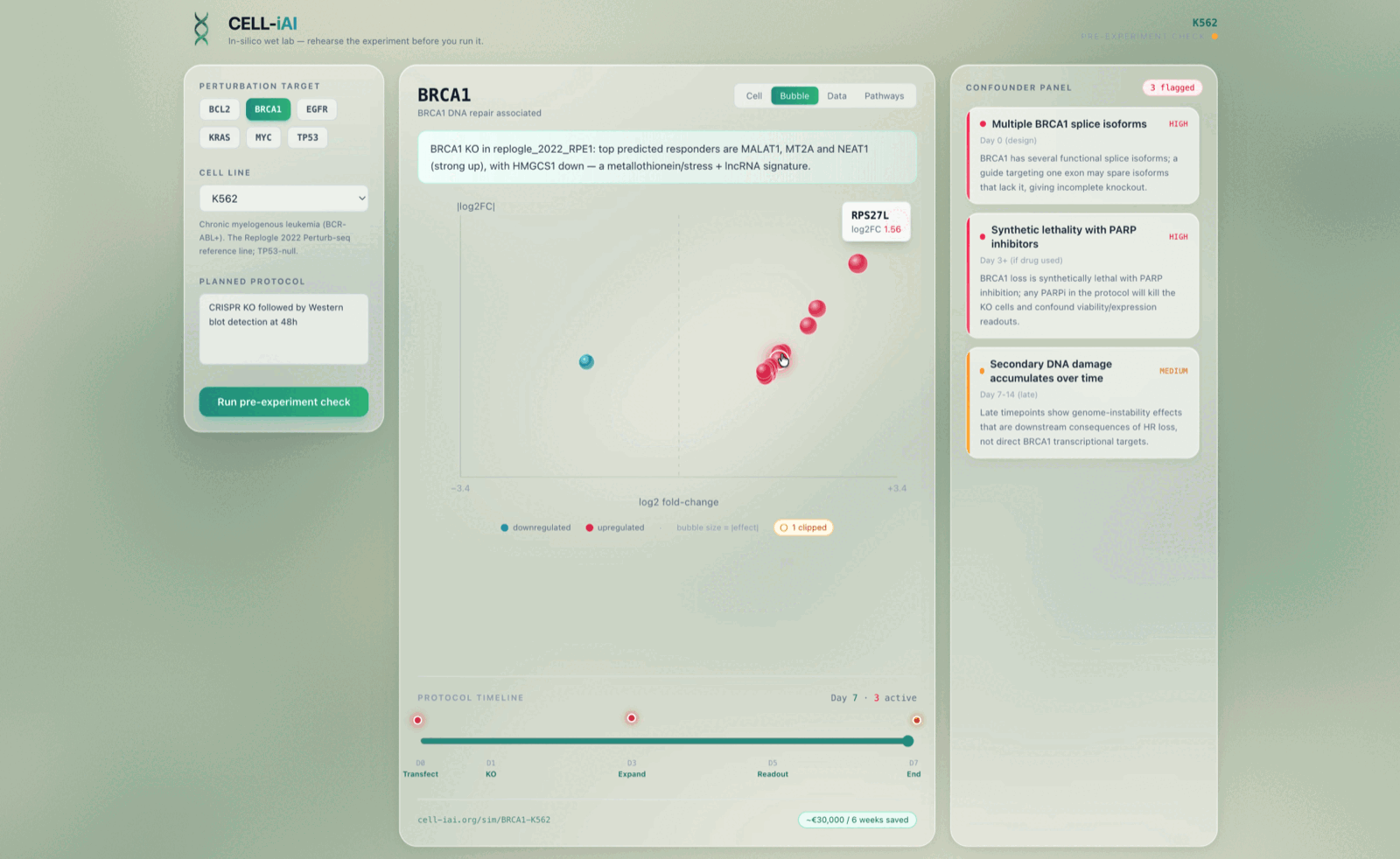
Built at the D4Gen 2026 hackathon at Genopole, Paris. A CRISPR knockout experiment costs tens of thousands of euros and weeks of bench time, and a large share of them fail for reasons that were predictable before anyone touched a pipette. CELL-iAI lets a biologist rehearse the experiment first: pick a target gene and a cell line, and it forecasts what the readout will look like.
Given a perturbation and a cell line, the model predicts transcriptome-wide expression shifts — log2 fold-changes across roughly 2,000 highly variable genes — without any wet-lab work. It also flags confounders that would muddy the result: for a BCL2 knockout it warns that BCL-XL and MCL1 upregulate to compensate, blunting the expected death phenotype; for BRCA1 it surfaces the synthetic lethality with PARP inhibitors that would confound any viability readout.
Under the hood, pluggable embedders turn genes into vectors — ESM2 protein-language embeddings or scGPT gene tokens — feeding a GenePT-embedding backbone whose streams are fused by a mixture-of-experts conditioned on cell type, with an MLP head regressing pseudobulk expression deltas. Train and validation are split by perturbation rather than at random, so the model is scored on genes it has never seen. KEGG pathway enrichment runs on the predictions, and the whole thing is served behind a FastAPI endpoint.
- TechnologiesPython, PyTorch, scGPT, ESM2, GenePT, Mixture-of-Experts, FastAPI, AnnData / H5AD
- EventD4Gen 2026 Challenge · Genopole, Paris
- Sourcegithub.com/sebgra/cell-iAI